
Dallas Airport (DFW)
Find useful information about Dallas Fort Worth International Airport: Arrivals, Departures, Terminal information, Parking, Car rental, Transport, Accommodation, Amenities and Services, among other information about Dallas Fort Worth Airport (DFW). Plan your travel to DFW Airport with the information provided in this guide.
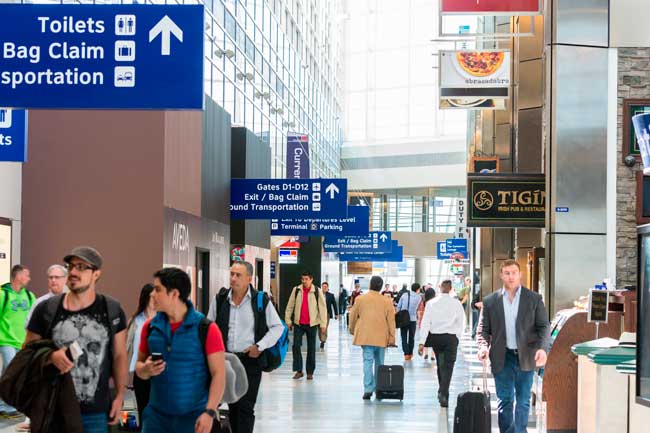


Dallas Fort Worth International Airport (IATA: DFW, ICAO: KDFW, FAA LID: DFW) is the main airport serving Dallas-Fort Worth metroplex area in Texas, United States.
Dallas Fort Worth Airport is located between the cities of Dallas and Fort Worth, across Dallas and Tarrant counties due to its size (larger than the island of Manhattan). Given this fact, the airport has portions of the cities of Euless, Grapevine, Irving and Coppell.
The distance to Dallas is 20 miles (32 km) and to Fort Worth is 24 miles (38 km).
Dallas Fort Worth Airport is the third busiest airport worldwide and a hub for American Airlines.
Dallas Fort Worth Airport is a hub for American Airlines, Southwern Airways Express, Ameriflight and UPS Airlines. And a focus city for Frontier Airlines, Spirit Airlines and Sun Country Airlines.
During 2022, Dallas Fort Worth Airport registered 73,362,946 passengers.
Terminals + info
Dallas Fort Worth Airport consist of five terminals, all of them designed in a circular way.
Terminal A: Used mainly by American Airlines flights. Hosts gates A6 to A39.
Terminal B: Exclusively used by American Eagle. Hosts gates B1 to B49.
Terminal C: Exclusively used by American Airlines. Hosts gates C2 to C39.
Terminal D: The International Terminal. Hosts gates D5 to D40.
Terminal E: Used by the following airlines: Air Canada, Alaska, American, Delta, Frontier, JetBlue, Spirit, United and Westjet. Hosts gates E2 to E38.
Facilities and Services + info
Dallas Fort Worth Airport offers the following services to passengers:
- Free power stations
- ATMs
- Cellular broadband
- Travelex currency exchange
- Manicure & pedicure
- Massage therapist
- Pre-paid phone cards
- Shoeshine
About Dallas
Dallas is the largest city of the state of Texas. Given the size of Dallas, some sections of the city are in other counties such as Collin, Denton, Kaufman and Rockwall counties.
Transport + info
The following means of transport are available at Dallas Fort Worth Airport to get to the city center:
Inter-Terminal Transportation: All Airport Terminals (A to E) are connected each other and the parking lots by the free-to-use Skylink trains.
See more information
Bus: By taking Bus Route 408 you can get straight to Centre Port (downtown Dallas).
See more information
Taxi: Get within 24 minutes to Dallas by taxi. The fastest and safest way to downtown!
See more information
Light Rail: The DART Orange Line between DFW Airport and downtown Dallas may be helpful during your journey to the city center.
See more information
Train: TRE commuter services are available at DFW Airport Station.
See more information
Transfers: If you want private transportation to and from the Airport, you can book a transfer.
See more information
Car rental: Rent a car through our search engine or in the Car Rental center at the south entrance of DFW Airport.
See more information
Contact
Address: 2400 Aviation Drive, TX 75261, Dallas, Texas, UNITED STATES
Phone: +1 (972) 236 4968
Email: airportinfocenter@dfwairport.com
